WhatsApp Message Templates: Categories, Rules, Examples & Approval | ChatKar
Learn WhatsApp message template categories, rules, examples, approval requirements, quality signals, rejection reasons and best practices for businesses.
WhatsApp Message Templates: Categories, Rules, Examples & Approval
WhatsApp message templates are pre-approved message formats that businesses use for business-initiated communication on the WhatsApp Business Platform.
Templates are important for marketing, utility and authentication workflows, as well as business-initiated conversations outside the applicable customer service window.
This guide explains WhatsApp template categories, how templates work, approval rules, examples, common rejection reasons, quality signals, variables, buttons and best practices for creating templates that are clear, useful and aligned with WhatsApp requirements.
Quick Answer: What Is a WhatsApp Message Template?
A WhatsApp message template is a structured business message format that can be reviewed and approved for use on the WhatsApp Business Platform. Templates can contain text, variables and supported interactive or media elements depending on the template format.
Businesses commonly use templates for:
Offers, promotions, product recommendations and re-engagement.
Orders, payments, appointments and account updates.
OTPs and identity-verification messages.
Approved templates used to start conversations.
WhatsApp's current Business Policy states that businesses may initiate conversations on the Business Platform only with approved message templates. During the applicable 24-hour customer-service window, businesses can respond to users without a template. :contentReference[oaicite:1]{index=1}
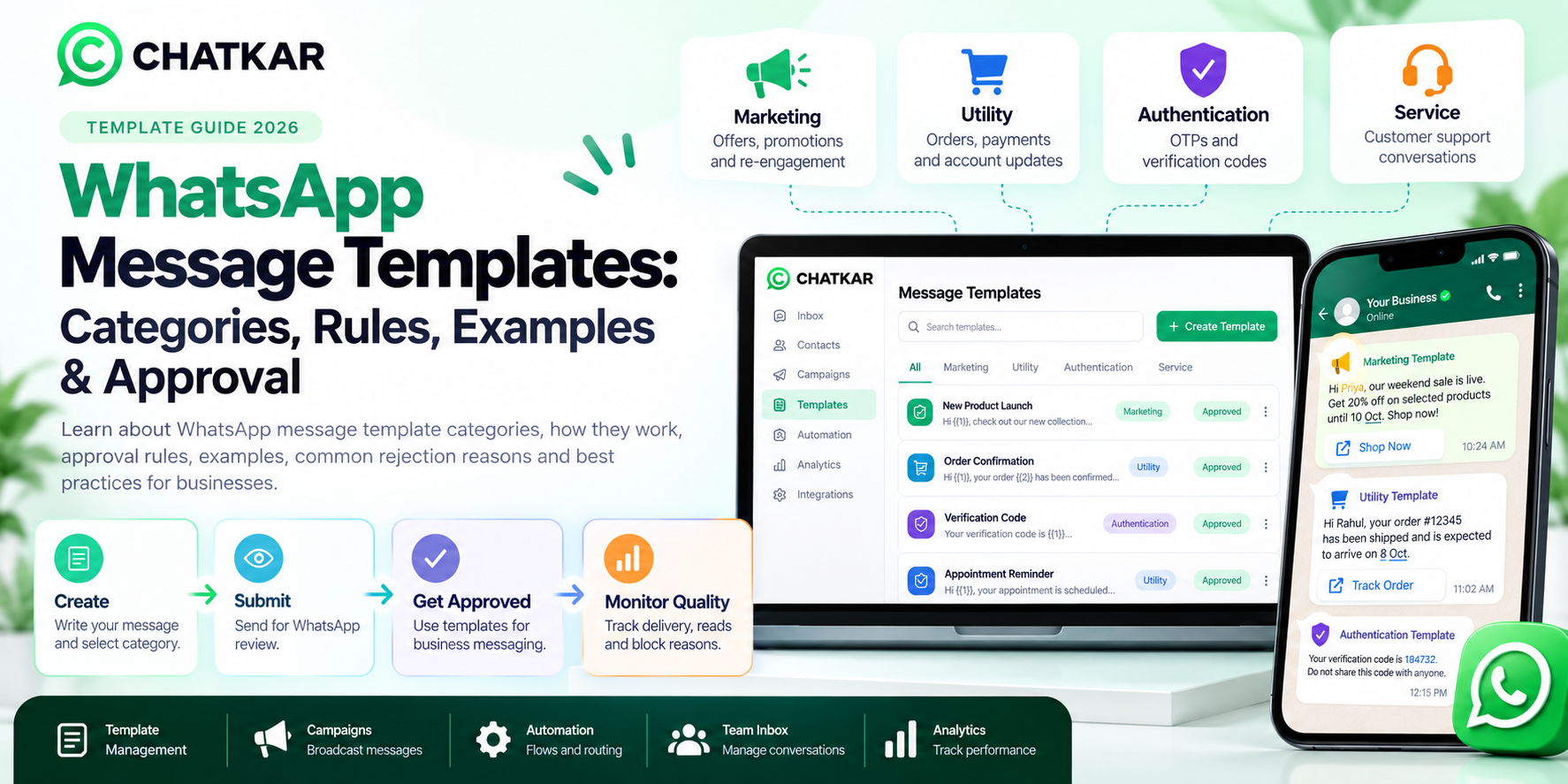
WhatsApp Message Template Categories
Choosing the correct category is one of the most important parts of template creation. The message content and purpose should match the category selected.
1. Marketing Templates
Marketing messages are used for promotional and customer-engagement purposes. WhatsApp describes marketing messages as covering awareness, sales, loyalty and re-engagement use cases. :contentReference[oaicite:2]{index=2}
Common use cases
- New product announcements
- Discounts and offers
- Price-drop notifications
- Product recommendations
- Abandoned-cart reminders
- Customer re-engagement
- Loyalty campaigns
Hi {{1}}, our weekend collection is now live. Explore the latest products and enjoy {{2}} off until {{3}}.
2. Utility Templates
Utility messages are generally tied to a customer action, transaction, account or other requested or important update. WhatsApp's current guidance includes order updates, account alerts, payment reminders and similar transaction-related communications. :contentReference[oaicite:3]{index=3}
Common use cases
- Order confirmations
- Payment updates
- Shipping and delivery updates
- Appointment reminders
- Account alerts
- Subscription updates
- Feedback requests
Hi {{1}}, your order {{2}} has been confirmed and is expected to arrive on {{3}}. Track your order here: {{4}}
3. Authentication Templates
Authentication messages are used to send one-time passcodes for identity verification, account creation, recovery and related authentication workflows. WhatsApp provides specific authentication capabilities for these use cases. :contentReference[oaicite:4]{index=4}
Common use cases
- Login OTP
- New account verification
- Account recovery
- Identity verification
- Authentication during supported transactions
Your verification code is {{1}}. Do not share this code with anyone.
4. Service Messages
Service messages are used for customer-service interactions, particularly when a user has already contacted the business.
During the applicable 24-hour customer-service window, businesses can respond to customer messages without using a message template. WhatsApp's current Business Platform guidance distinguishes these service interactions from business-initiated template messaging. :contentReference[oaicite:5]{index=5}
Customer: Can you tell me where my order is?
Business: Sure. Please share your order number.
How to Choose the Correct Template Category
Do not choose a category simply because it appears cheaper or more convenient. The category should match the actual purpose of the message.
What Can a WhatsApp Message Template Contain?
Depending on the template format and supported features, businesses can structure templates using different message components.
Text or supported media depending on the template type.
The main message content.
Dynamic information such as names, order numbers or dates.
Supported action or reply options where applicable.
Optional supporting text depending on the template format.
How to Use Variables in WhatsApp Templates
Variables allow businesses to insert dynamic information into a template without creating a completely new template for every customer.
Template:
Hi {{1}}, your order {{2}} is scheduled for delivery on {{3}}.
In this example:
- {{1}} can represent the customer's name.
- {{2}} can represent the order number.
- {{3}} can represent the expected delivery date.
Keep variables easy to understand and ensure your system always supplies valid values. Avoid creating templates that are almost entirely made up of unexplained variables.
WhatsApp Message Template Examples
Marketing Template Example
Hi {{1}}, our weekend sale is live. Get {{2}} off selected products until {{3}}. Shop now: {{4}}
Category: Marketing
Utility Template Example
Hi {{1}}, your order {{2}} has been shipped and is expected to arrive on {{3}}.
Category: Utility
Authentication Template Example
{{1}} is your verification code. Do not share this code with anyone.
Category: Authentication
Appointment Template Example
Hi {{1}}, your appointment with {{2}} is scheduled for {{3}} at {{4}}. Please contact us if you need to reschedule.
Category: Usually Utility when it is genuinely related to an appointment or requested transaction.
How WhatsApp Template Approval Works
Template approval is not simply a matter of submitting any marketing message and waiting for it to go live.
Write the message and select the intended category.
Check content, variables, purpose and policy alignment.
Submit the template through the supported WhatsApp business tooling.
Monitor whether the template is approved, pending, rejected or paused.
WhatsApp states that it may review, approve, pause or reject message templates and that templates must follow its policies and be used only for their designated purposes. :contentReference[oaicite:6]{index=6}
WhatsApp Template Quality: Why It Matters
Approval is not the end of the process. Template quality can affect how your messaging performs over time.
WhatsApp's current Business Manager template tooling exposes information such as template status, quality rating, delivered messages, read rate and top block reasons. :contentReference[oaicite:7]{index=7}
Are messages reaching users?
Are customers opening messages?
Are users rejecting the communication?
Does the template continue to provide a good experience?
Businesses should therefore treat template quality as an ongoing operational metric rather than something that matters only during submission.
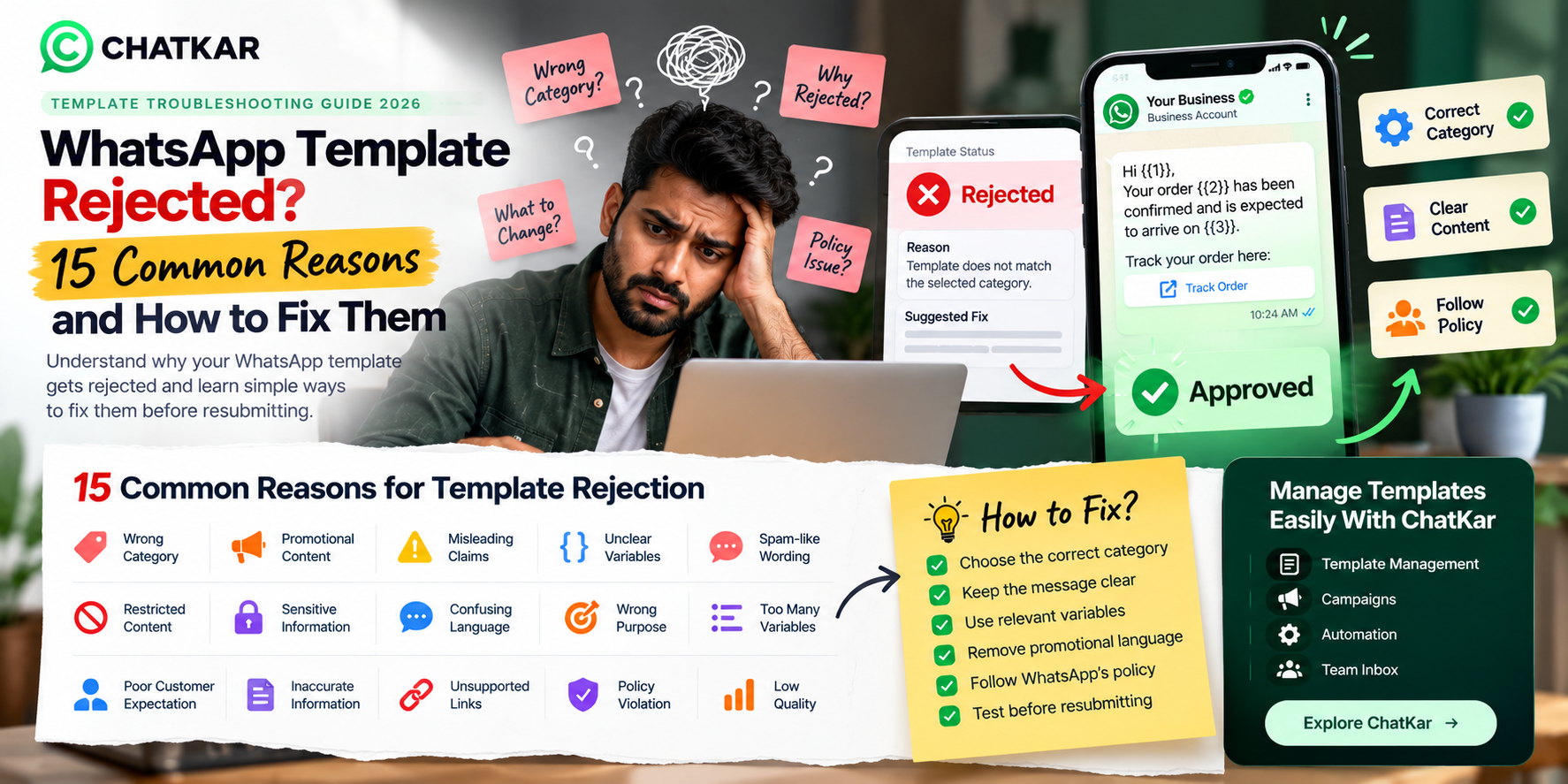
Common Reasons WhatsApp Templates Can Be Rejected
The exact reason for a rejection depends on the submitted content and current WhatsApp review criteria, but common problem areas include:
The actual content does not match the category selected during submission.
A message presented as transactional or service-related may contain promotional language that changes its purpose.
Variables are poorly positioned, not properly explained or depend on unreliable values.
The message contains claims or wording that may conflict with applicable WhatsApp or business policies.
Excessive, irrelevant or unwanted messaging can lead to blocks and reports, which can affect business messaging quality.
Bad vs Better WhatsApp Template Examples
Poor Example
Hello!!! Amazing OFFER!!! Buy NOW and get the BEST PRICE!!! Click immediately!!!
Problems: excessive promotional language, poor clarity and weak relevance.
Better Example
Hi {{1}}, our weekend offer is now available. You can save {{2}} on selected products until {{3}}. View the offer: {{4}}
Clear purpose, readable structure and useful customer context.
WhatsApp Message Template Best Practices
Choose the category that genuinely matches the message purpose.
Write for a customer, not for a template reviewer.
Make every variable meaningful and predictable.
Especially inside messages whose purpose is transactional.
Communicate only with users who have appropriately opted in where required.
Review delivery, reads, blocks and other available quality signals.
WhatsApp's current policy emphasizes quality experiences, appropriate consent and respecting user expectations. Users can block or report businesses, and WhatsApp may take action where messaging quality remains low. :contentReference[oaicite:8]{index=8}
A Practical WhatsApp Template Workflow
Building templates this way helps businesses avoid treating message creation as a simple copy-paste exercise. The message should first solve a real business communication need.
Create and Manage WhatsApp Templates With ChatKar
ChatKar brings WhatsApp messaging workflows, templates, team inboxes, campaigns and automation into one business workspace.
Instead of creating a template and then managing everything separately, businesses can connect templates with the workflows where those messages are actually used.
Organize business messaging templates.
Connect templates to messaging campaigns.
Use templates inside business workflows.
Move from automation to human assistance.
ChatKar also provides template-related workflow tools designed to help businesses prepare and manage their WhatsApp messaging operations.
Related WhatsApp Business Guides
Understand what the API is and how businesses use it. WhatsApp API Pricing in India
Understand message categories, costs and budgeting. WhatsApp API vs Business App
Compare the two approaches for different business needs. How to Get WhatsApp Business API
Follow the setup and onboarding process.
Frequently Asked Questions
What is a WhatsApp message template?
A WhatsApp message template is a structured business message format that can be reviewed and approved for eligible Business Platform use cases.
What are the main WhatsApp template categories?
The main categories are Marketing, Utility, Authentication and Service. Service conversations are primarily customer-service interactions, while templates are especially important for business-initiated messaging.
Do all WhatsApp messages need templates?
No. Businesses can respond to a user without a template during the applicable 24-hour customer-service window. Business-initiated conversations require approved templates under the current WhatsApp Business Platform rules.
Why was my WhatsApp template rejected?
Rejections can happen for several reasons, including category mismatch, content-policy issues, unclear variables, unsupported claims or other problems identified during review. Check the status and feedback provided by the WhatsApp business tools.
Can a utility template contain promotional content?
A utility message should genuinely serve a utility or transactional purpose. Promotional content can change the nature of the message, so businesses should review the current category requirements rather than trying to classify marketing content as utility.
Can WhatsApp change a template's status?
Yes. WhatsApp can review, approve, pause or reject templates according to its policies and current enforcement systems. :contentReference[oaicite:9]{index=9}
How can I improve WhatsApp template quality?
Use relevant messaging, clear wording, accurate category selection, appropriate consent and useful customer communication. Also monitor delivery, read rate and block-related quality signals where available.
Can I use variables in WhatsApp templates?
Yes. Variables can be used to insert dynamic information such as names, order numbers, dates and other customer-specific values where supported by the template format.
Can I create WhatsApp templates with ChatKar?
ChatKar provides tools for managing WhatsApp messaging templates and connecting them with campaigns and automation workflows.
Final Thoughts
WhatsApp message templates are more than pre-written messages. They are part of the structure businesses use to communicate with customers through the WhatsApp Business Platform.
The best results come from matching the template to the actual customer journey:
Avoid trying to manipulate categories simply to reduce costs or increase approval chances. Build messages that genuinely provide value to the customer, follow WhatsApp's current rules and are connected to a useful business workflow.
A centralized platform can make it easier to organize templates, connect them with campaigns and automation, and move conversations to a human team when required.
Ready to Manage WhatsApp Templates More Efficiently?
Create, organize and connect WhatsApp templates with campaigns, automation, team inboxes and business workflows through ChatKar.
Explore Features View Pricing